Presented by Philips in March 1979, the experimental digital audio system demonstrated a radically different way of storing and playing music. Using optical readout and digital encoding, it suggested a future beyond the limitations of the long-playing record.
This page looks at that early system not simply as a prototype, but as the moment when Philips moved digital audio from laboratory research into the public eye. It explores the people behind the project and the strategic decisions that would eventually lead to the Compact Disc standard.
By the late 1970s, the audio industry was approaching a quiet turning point. Analog technology still dominated the consumer market. The long-playing record remained the primary music format, and compact cassettes had secured their place in portable and home audio systems. Yet beneath this stable surface, a new technological direction was beginning to emerge. Digital signal processing, once confined mainly to research laboratories and professional recording environments, was slowly moving closer to consumer applications.
This shift did not appear overnight. Laboratories in Europe, Japan, and the United States had been experimenting with digital audio recording and playback for years. The advantages were clear. Digital systems offered the possibility of reproducing sound with great precision and stability. Unlike analog media, they were not subject to gradual mechanical wear during playback. In theory, music could be reproduced again and again without degradation.
At the same time, the electronics industry had learned an important lesson during the previous decade. Technical superiority alone did not guarantee success. Several format battles had already taken place, particularly in the video sector. These conflicts made it clear that control over a standard could be just as important as the technology itself. A successful format required broad industrial support, compatibility between manufacturers, and confidence from consumers.
It was in this climate that digital audio began to evolve from a laboratory experiment into a possible new consumer format.
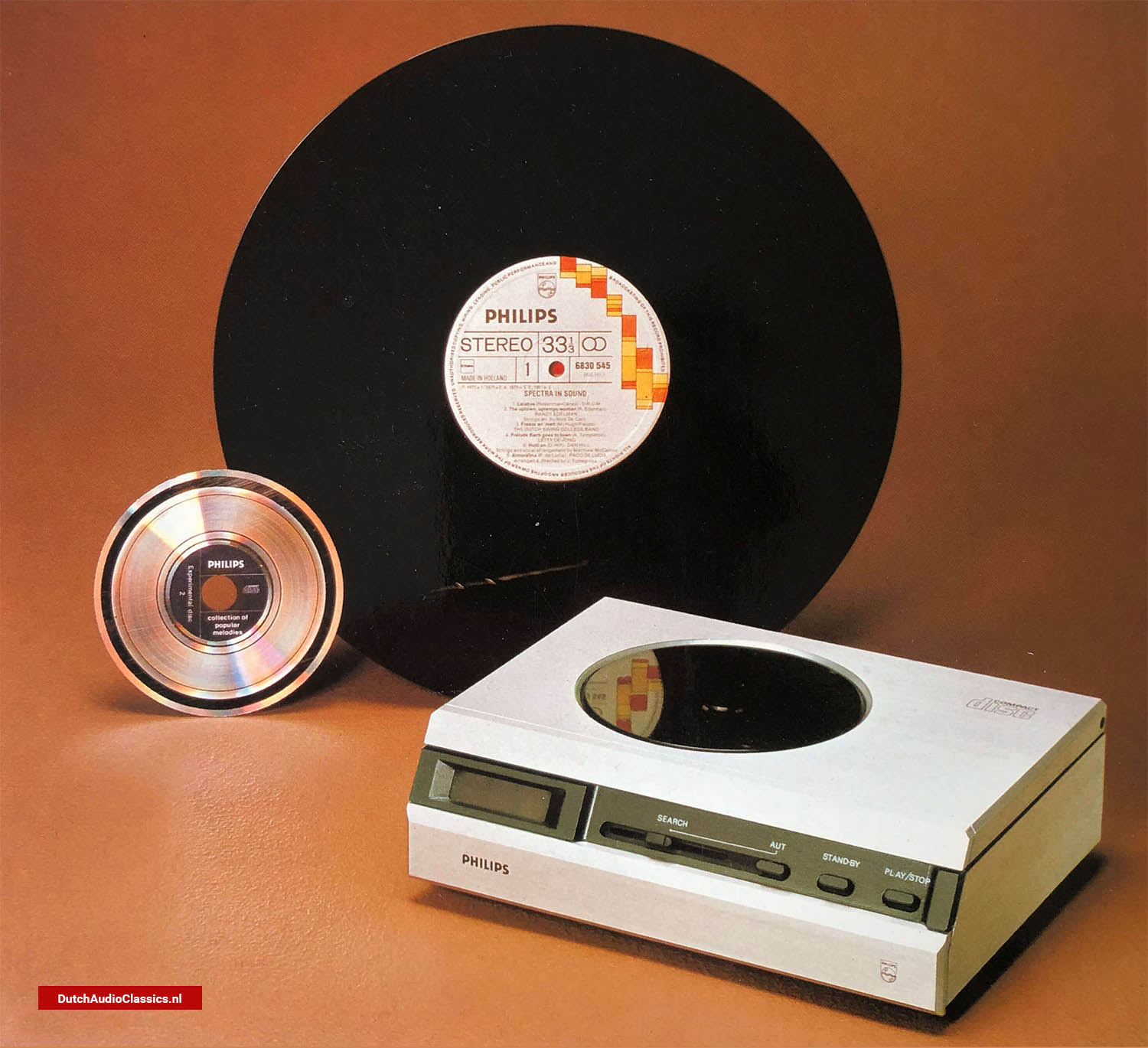
![The First Public Demonstration of the Philips Compact Disc]() Philips Pinkeltje
Philips Pinkeltje
Philips at the End of the Seventies
Within Philips, optical storage technology had been an active research field for several years. The company had developed extensive expertise in lasers, optical readout systems, and digital signal processing. This knowledge formed the basis for experiments with optical discs capable of storing digital information.
At the head of Philips Audio at the time was Joop van Tilburg, General Director of the audio division. He faced a strategic question: how could Philips translate its strong research position into a viable consumer technology?
Lou Ottens, Technical Director of the audio group, played a key role in shaping that direction. Ottens had previously been closely involved in the development of the compact cassette, one of Philips’ most successful consumer formats. His experience with format development made him particularly aware of the importance of timing, presentation, and industry support.
The practical development of the digital audio disc took place in a specialized research group. The CD laboratory was led by Joop Sinjou, who coordinated a small team of engineers working on the implementation of an optical digital audio system.
Within that team, several disciplines came together. Hans Mons focused on the electronic architecture of the system, including digital signal processing and the conversion of digital data into analog audio. Jacques Heemskerk was responsible for the optical side of the project. His work centered on the laser readout system and the stability of the optical mechanism.
Interestingly, the nickname of the prototype system was also linked to this team. The internal name “Pinkeltje” was coined by Hans Mons. The name referred to a small character from Dutch children’s literature and was used humorously to describe the remarkably compact disc that formed the heart of the system.
The project was therefore not an isolated laboratory experiment. It stood at the intersection of research, product strategy, and industrial planning. Philips understood that a new audio medium would only succeed if it could gain international acceptance.
For that reason, the work involved more than electronics and optics. It also involved timing, communication, and international cooperation.
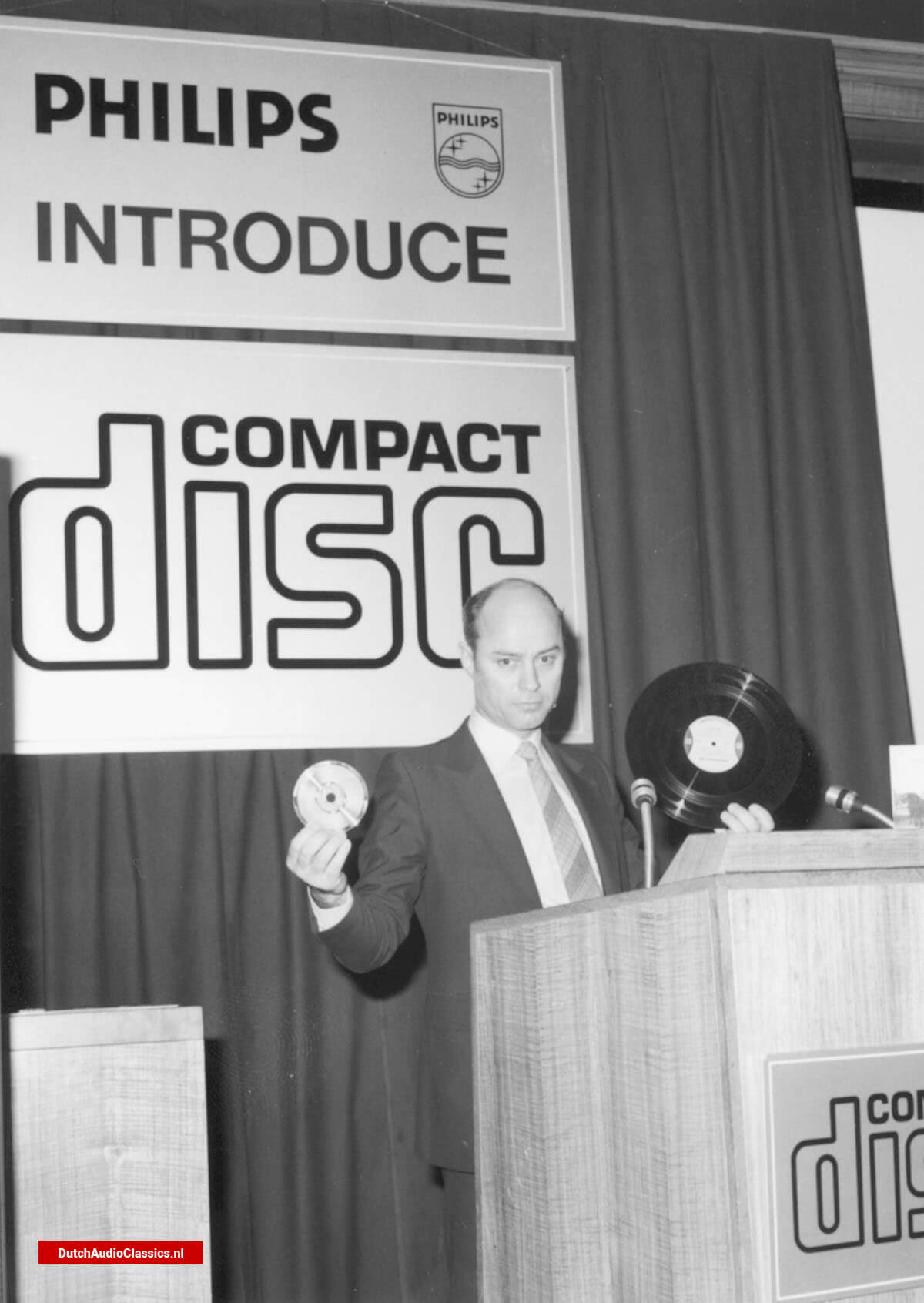 Joop Sinjou at the demonstration of the Compact Disc system, 8 March 1979
Eindhoven, 8 March 1979
On March 8, 1979, Philips decided the moment had come to show the technology to the outside world.
In Eindhoven, the company organized a demonstration for around three hundred international technology journalists. During this event, the experimental digital audio system known internally as “Pinkeltje” was presented publicly for the first time.
The system was clearly still a prototype. Nevertheless, Philips presented it with a bold message. The digital audio disc was positioned as a possible successor to the long-playing record.
For the journalists present, this was one of the first public demonstrations of a digital audio carrier designed for home use. The system was not intended as a professional studio device. Instead, it was shown as a concept for a future consumer format.
Visually, the device appeared surprisingly compact. It used an optical disc that was much smaller than a traditional LP. This alone suggested a very different future for music media.
The fact that the system was still under development did not reduce the significance of the demonstration. In fact, the opposite was true. By presenting the technology at this early stage, Philips was sending a clear signal to the industry.
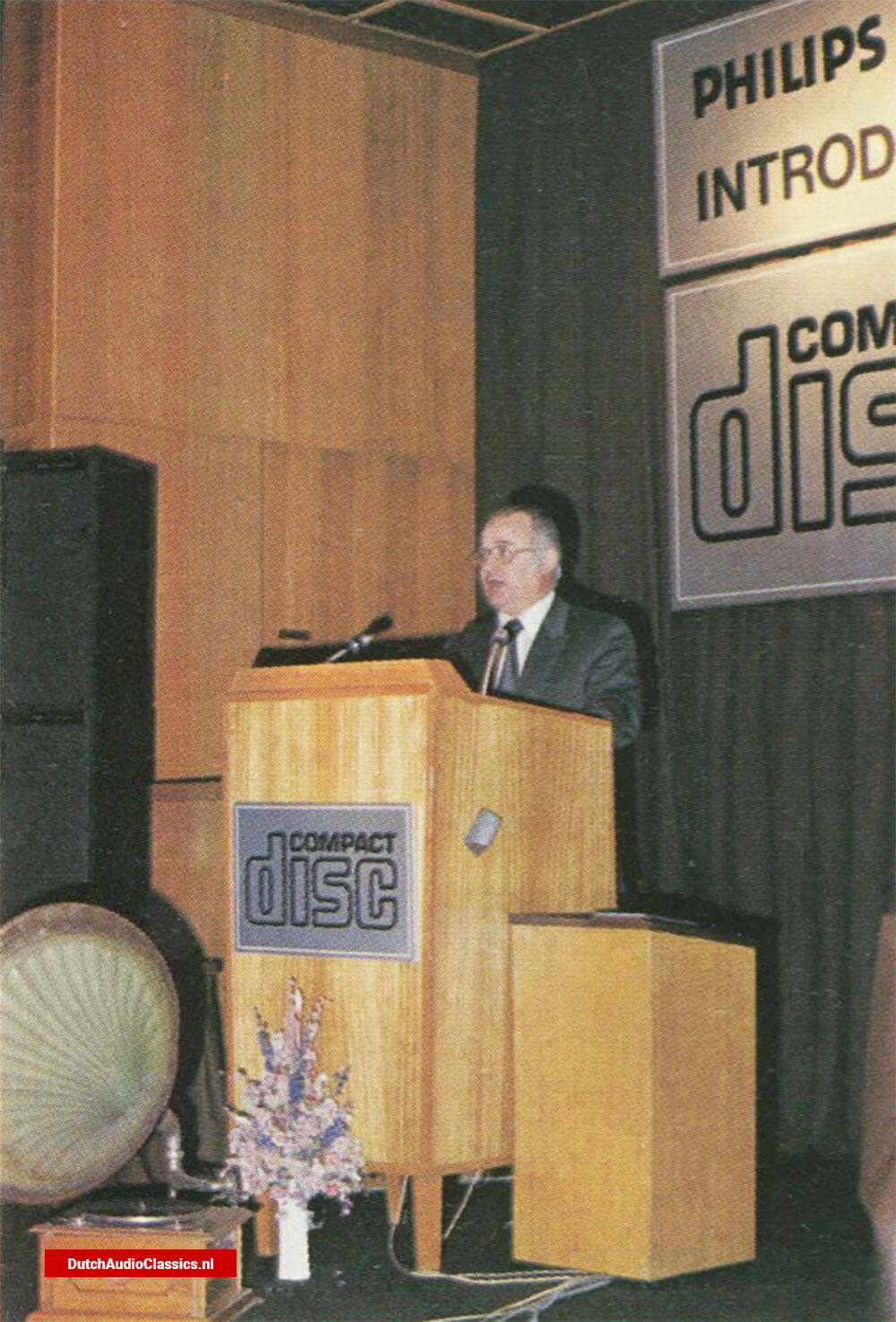 Joop van Tilburg welcomes the international press to the world premiere of the Philips Compact Disc System on 8 march 1979
Understanding the Philips “Pinkeltje” Prototype
What exactly was the “Pinkeltje” system?
An experimental digital audio playback system developed by Philips and first demonstrated in Eindhoven in March 1979. It showed how music could be stored and reproduced digitally using a small optical disc.
Why was the demonstration so important?
Because Philips presented a working concept of a digital consumer format before such a format formally existed. The system showed that optical digital audio could become a practical replacement for the long-playing record.
Why does the Pinkeltje prototype still matter today?
Because it marks the moment when digital audio moved from laboratory research into public view. The demonstration helped start the international process that would eventually lead to the Compact Disc standard.
 Hans Mons at age 34, shown on the right, shows a compact disc to the press.
The Technical Core of the Prototype
The system demonstrated in Eindhoven used digital audio encoding based on Pulse Code Modulation. The prototype operated with a resolution of 14 bits and a sampling frequency of approximately 44.3 kilohertz. This combination allowed a frequency range comparable to, and in some respects wider than, that of the long-playing record.
The optical disc itself had a diameter of about 11.5 centimeters. This made the medium significantly smaller than an LP, while still offering enough capacity for a practical playing time.
However, the demonstration setup also revealed its laboratory origins. The compact disc mechanism was connected to a large external electronics rack. Inside this rack were the digital circuits required to process the data read from the disc, decode it, and convert it into an analog audio signal.
Here, the work of Hans Mons played an important role. His electronic architecture enabled the system to process the digital data stream and transform it into an audio signal that could be played through conventional amplifiers.
At the same time, the optical system developed under Jacques Heemskerk was responsible for reading the digital information from the disc with great precision. The stability of the laser, the positioning of the optics, and the accuracy of the tracking mechanism were all crucial to the system’s operation.
This configuration was typical for the development phase. Many of the required electronic functions still relied on separate modules and experimental circuitry. Integrated solutions such as the later digital signal processors and D/A converter chips had not yet been developed.
In a sense, the demonstration showed two different worlds at once. At the front stood a compact device that resembled a future consumer product. Behind it operated a large amount of laboratory hardware.
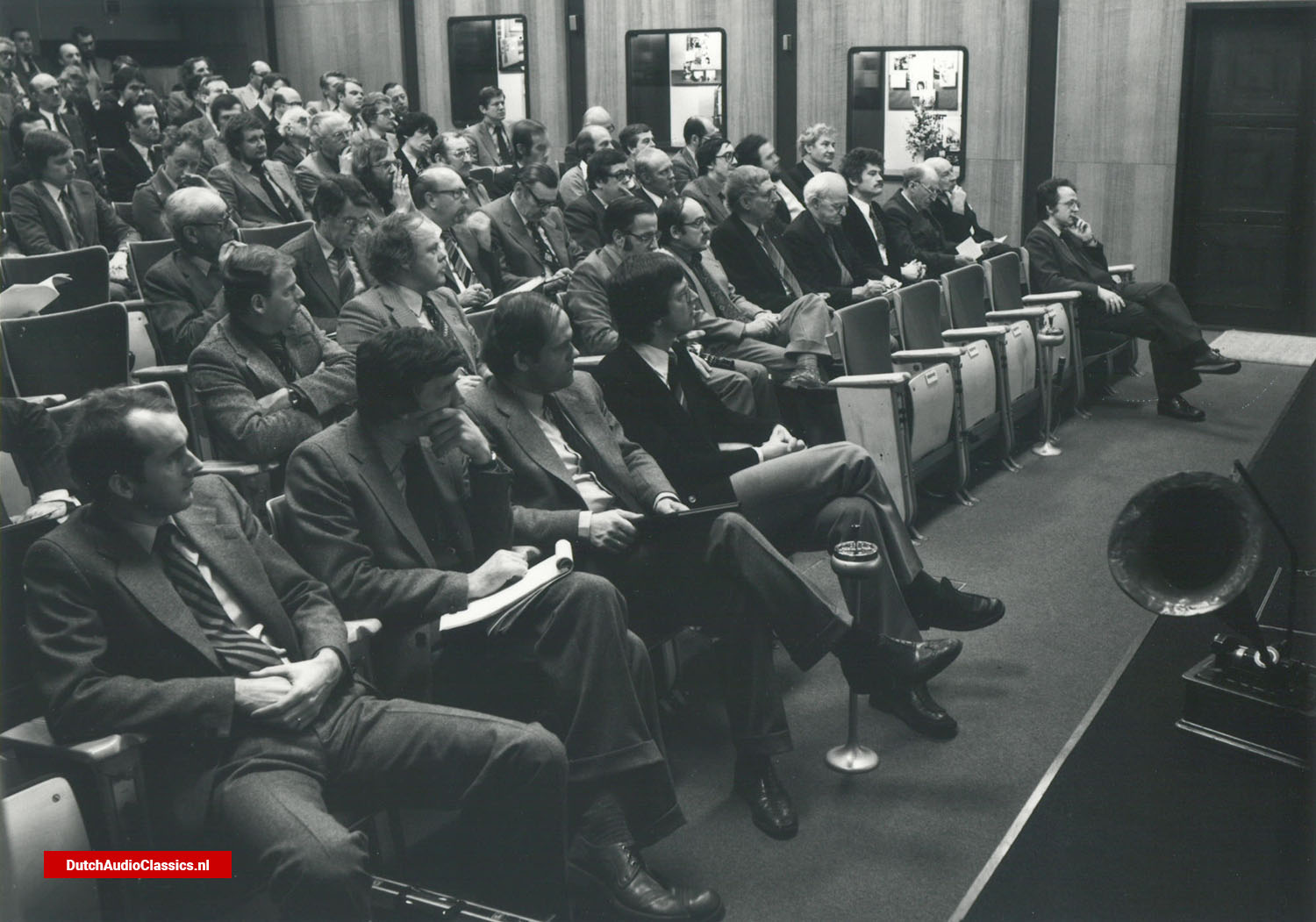 On March 8, 1979, the introduction of the Philips Compact Disc System was held in a hall filled with journalists. On the right side is Hans Mons.
Presenting a Vision of the Future
This combination was not accidental.
Philips understood that new technology is difficult to communicate when it exists only as diagrams or research papers. By presenting a tangible device, the company could create a clear and convincing picture of what digital audio might look like in the future.
The small mechanism and compact disc therefore served as a visual argument. They showed that digital audio could eventually become part of a normal living-room audio system.
The fact that much of the signal processing still relied on external hardware was less important for the demonstration. The direction was clear. As the technology matured, integration and miniaturization would follow.
Within Philips, this vision was also supported at the strategic level. Figures such as Lou Ottens and Joop van Tilburg recognized that a convincing demonstration was necessary to gain interest from other manufacturers and industry partners.
In that sense, the event was not only a technical demonstration. It was also a carefully constructed glimpse of a possible future.
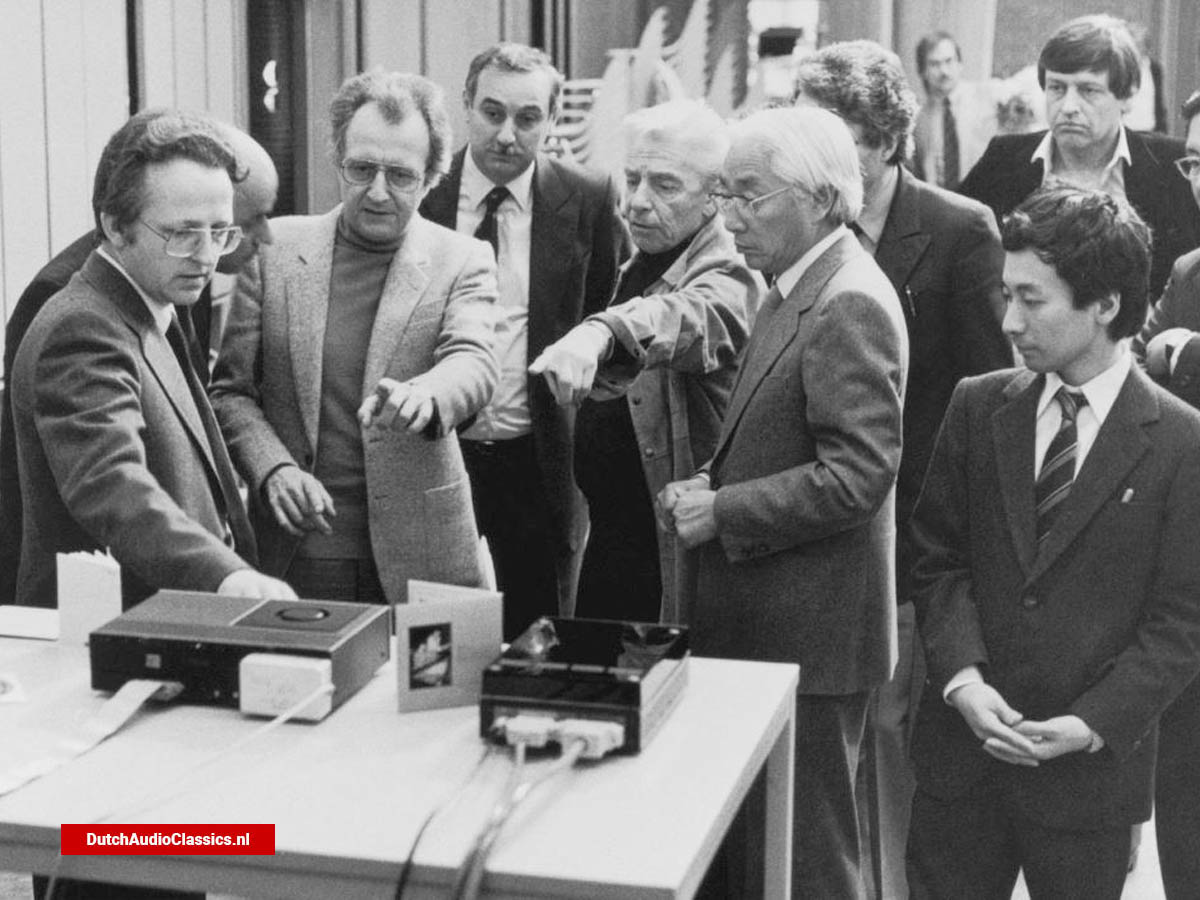 From left to right: Hans Mons, Jacques Heemskerk, Herbert von Karajan, Akio Morita (Sony), April 1981
Looking Toward Japan
The Eindhoven demonstration was only the first step. Shortly afterward, a Philips delegation traveled to Japan to present the system to several companies within the Japanese electronics industry.
One of the important presentations took place before a committee of Japan’s Ministry of International Trade and Industry, commonly known as MITI. At that time, Japanese companies were also exploring digital audio technologies. Several firms were developing their own approaches to digital music storage.
For Philips, it was therefore important to present its concept early.
The demonstrations in Japan had a clear strategic objective. By introducing the system before competing formats had fully emerged, Philips hoped to create a foundation for a shared international standard.
This approach would later prove decisive. In the months and years following these early demonstrations, cooperation between Philips and Sony began to take shape. The two companies combined their research and technical approaches into a joint system.
From that collaboration emerged the specification later known as the Red Book, which defined the technical parameters of the Compact Disc Digital Audio format.
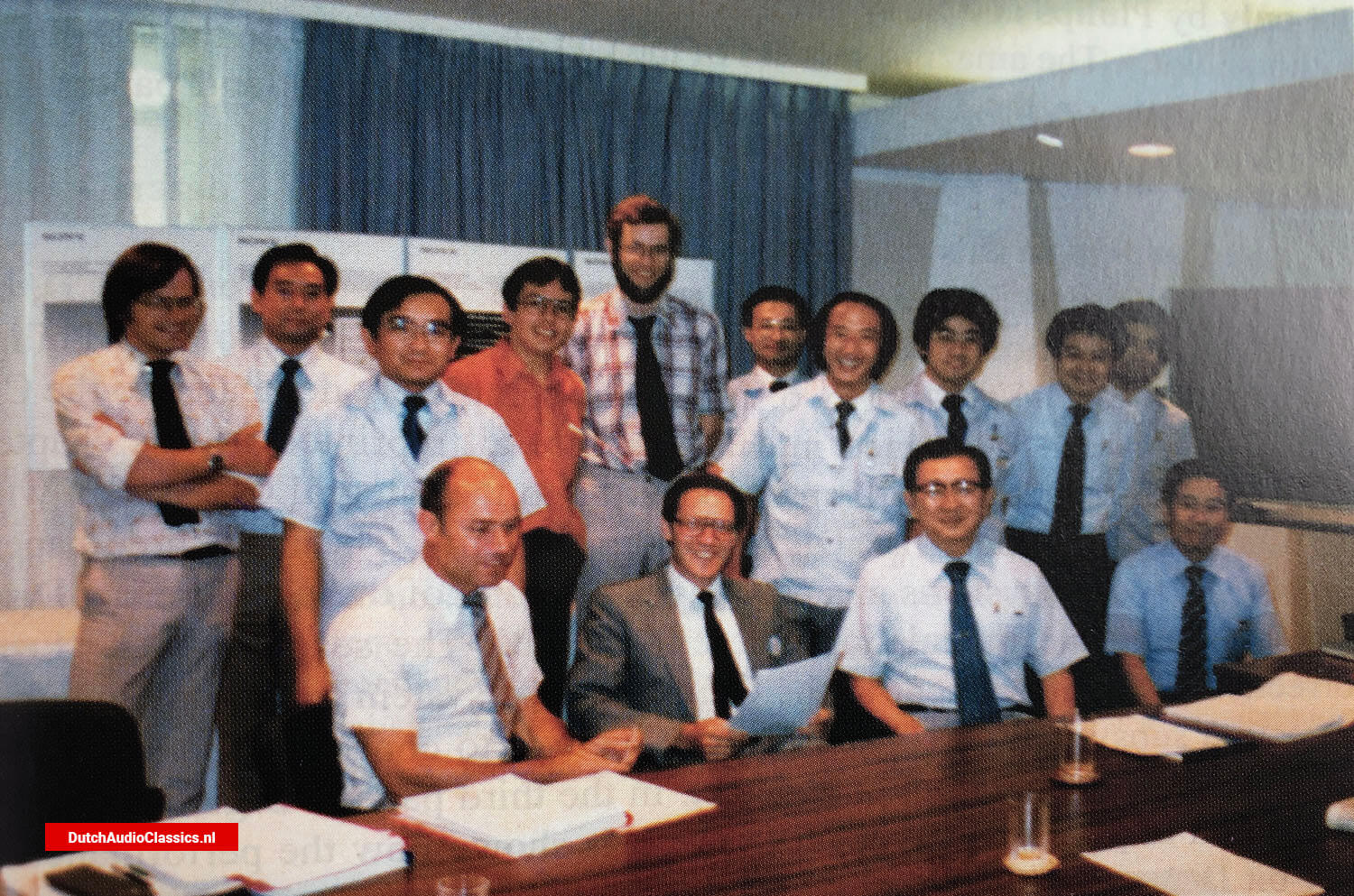 Tokyo, June 18 1980. From left to right: 2n row: Heemskerk, Harada, Miyaoka, Vries, Nijboer, Tsurushima, Doi, Ogawa, Naruse, Odaka. Front row: Sinjou, Bögels, Nakajima, Mizushima.
From Research Project to Global Standard
Looking back, the demonstration of March 1979 clearly marks a transition. What had previously been an internal research effort suddenly became visible to the outside world.
The technology itself was not yet finished. Many components still needed to be miniaturized, integrated, and refined. But the concept had now taken a clear public form.
The later success of the Compact Disc is often described as a technological revolution. Digital encoding, optical readout, and error correction were indeed essential elements.
Yet history shows that the eventual breakthrough was not purely technical. It resulted from a combination of technological development, strategic timing, and international cooperation.
The Eindhoven demonstration made the idea of a digital audio disc tangible. The subsequent presentations in Japan brought the concept to the attention of potential partners. Ultimately, the cooperation between Philips and Sony transformed the idea into a widely adopted international standard.
What began as a research project within a small team led by Joop Sinjou, with key contributions from engineers such as Hans Mons and Jacques Heemskerk, would grow into one of the most important technological standards in the history of music reproduction.
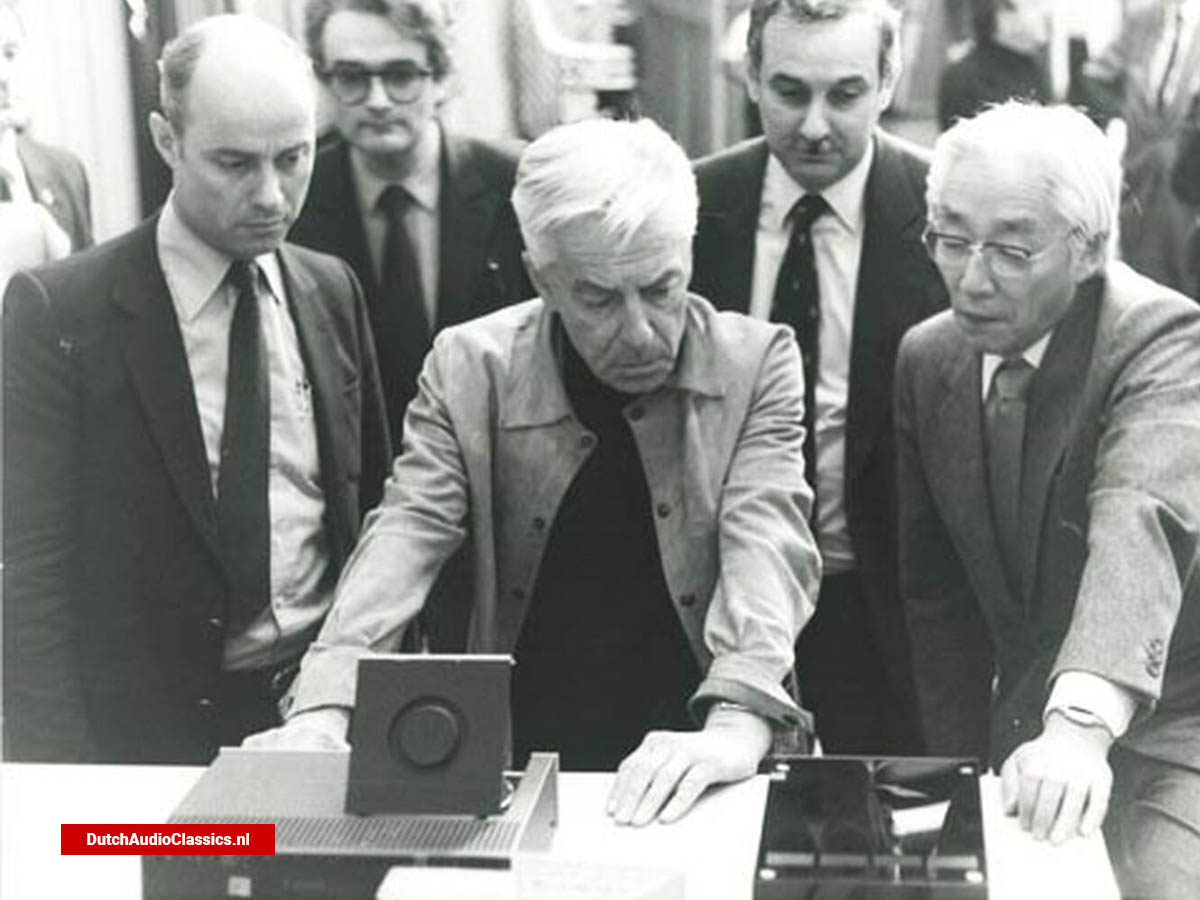 From left to right: Joop Sinjou (Philips), Herbert von Karajan, Akio Morita (Sony), April 1981 Salzburg
This page examines the first public introduction of the Philips Compact Disc system, demonstrated in Eindhoven on 8 March 1979.
Developed by the Philips digital audio team under Joop Sinjou, the prototype showed how music could be stored and reproduced on a small optical disc using digital encoding. The system, internally nicknamed “Pinkeltje” by engineer Hans Mons, was still supported by laboratory hardware but already revealed the core idea behind the future Compact Disc.
The demonstration marked the moment when Philips presented digital audio not just as research, but as a potential global consumer format.
 Philips Pinkeltje