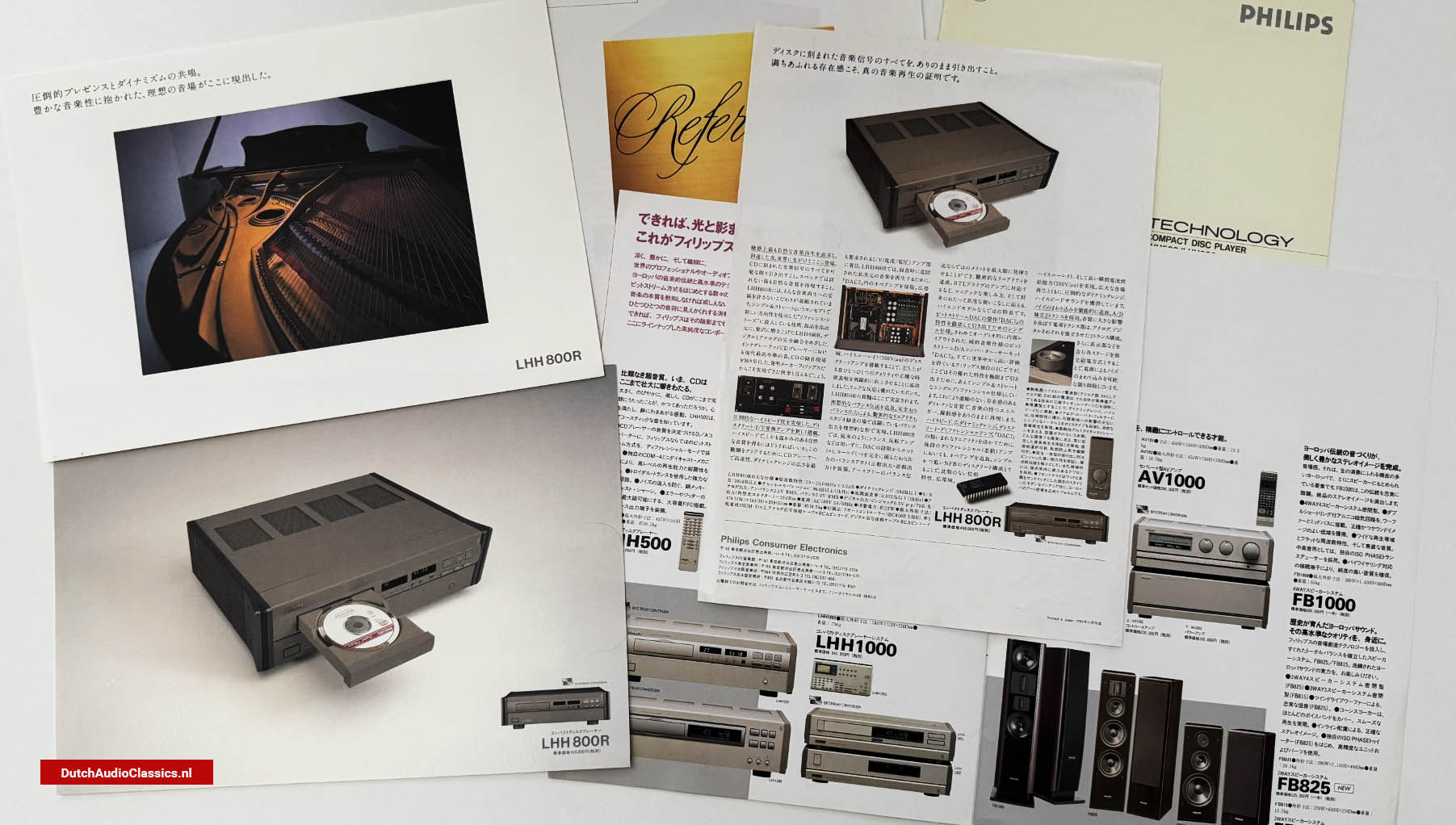
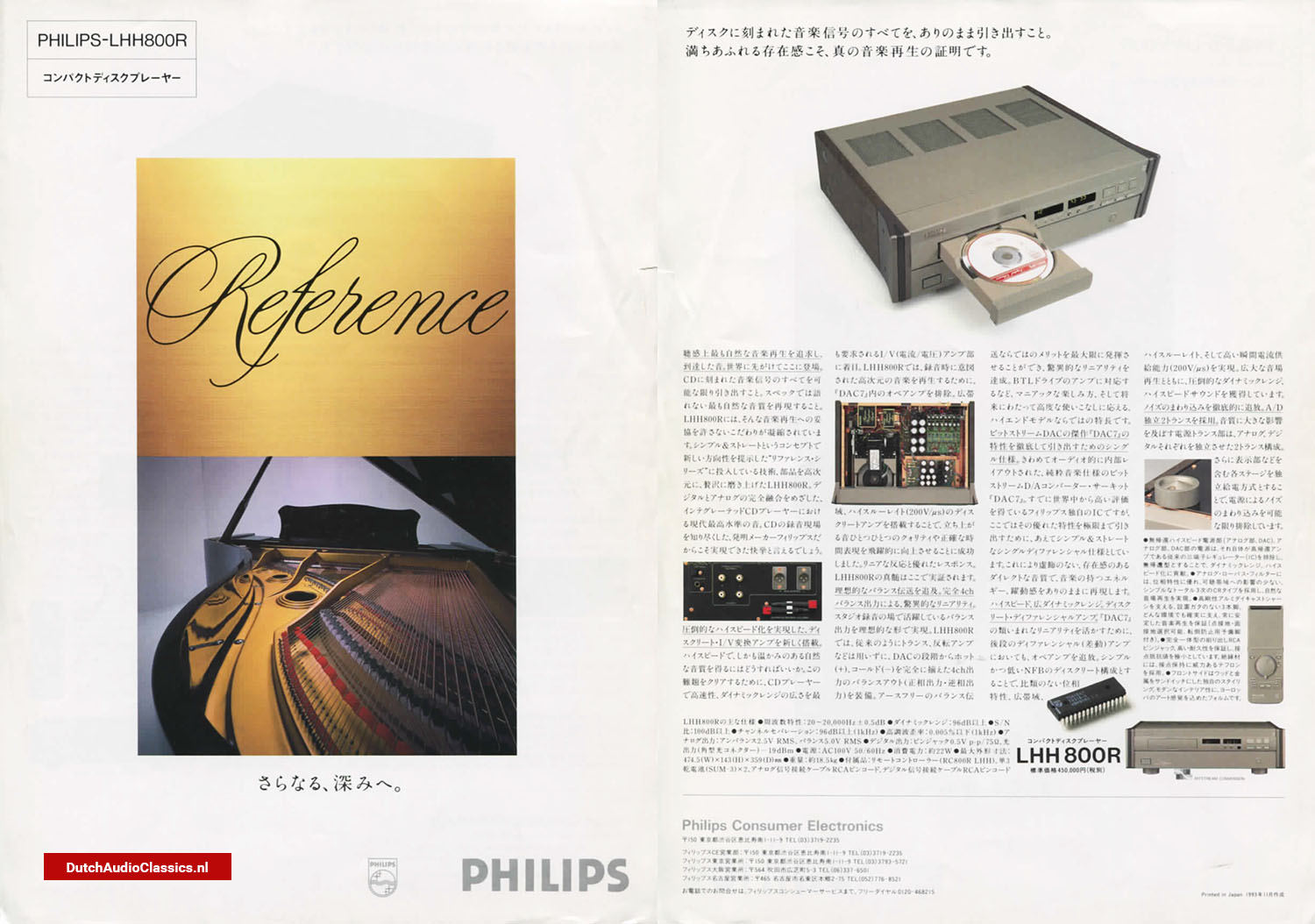
This blog examines the Philips LHH800R (1993) within the broader development of high-end CD players in the early 1990s. It explores how the player combined Philips’ DAC7 Bitstream platform with a distinctive discrete analog output stage developed in cooperation with Marantz Japan.
Placed within the context of Philips' LHH series for the Japanese audiophile market, the discussion highlights key design priorities such as simplified signal paths, high transient speed, and limited use of global negative feedback in the analog stage.
A Reference Player with an Unusual Philosophy
When the Philips LHH800R appeared in 1993, it was clear that this was not a typical CD player.
From the outside the machine looked solid and understated. Inside, however, the design followed a very specific idea. The digital section used Philips’ modern DAC7 bitstream system. The analog section took a different route. Instead of using complex feedback circuits and standard op-amps, the designers built a discrete output stage that focused on speed and a short signal path.
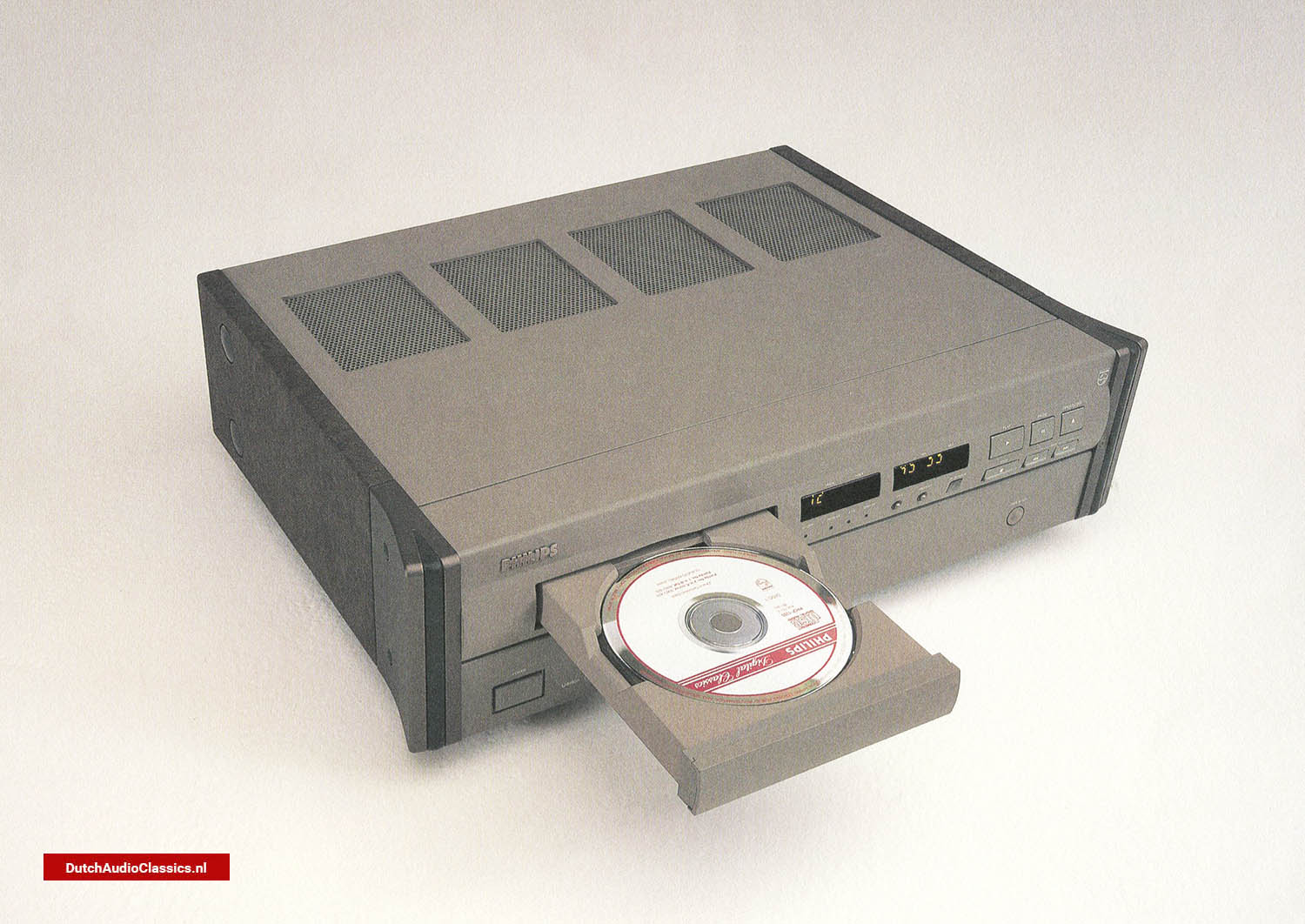
The LHH800R was developed mainly for the Japanese high-end market. At the time Japan had a strong audiophile culture. Enthusiasts were willing to invest in expensive digital equipment if it offered distinctive engineering.
Philips worked closely with Marantz Japan during development. Marantz engineers had a great deal of experience designing analog stages around Philips digital technology.
Within the LHH series the LHH800R served as the reference model. Production numbers were modest and the player targeted serious enthusiasts.
Looking back today, the LHH800R represents an interesting moment in digital audio history. It combines Philips’ new bitstream conversion with an analog stage that deliberately avoids heavy feedback.
The result is a player that approaches digital playback in a slightly different way than many of its contemporaries.
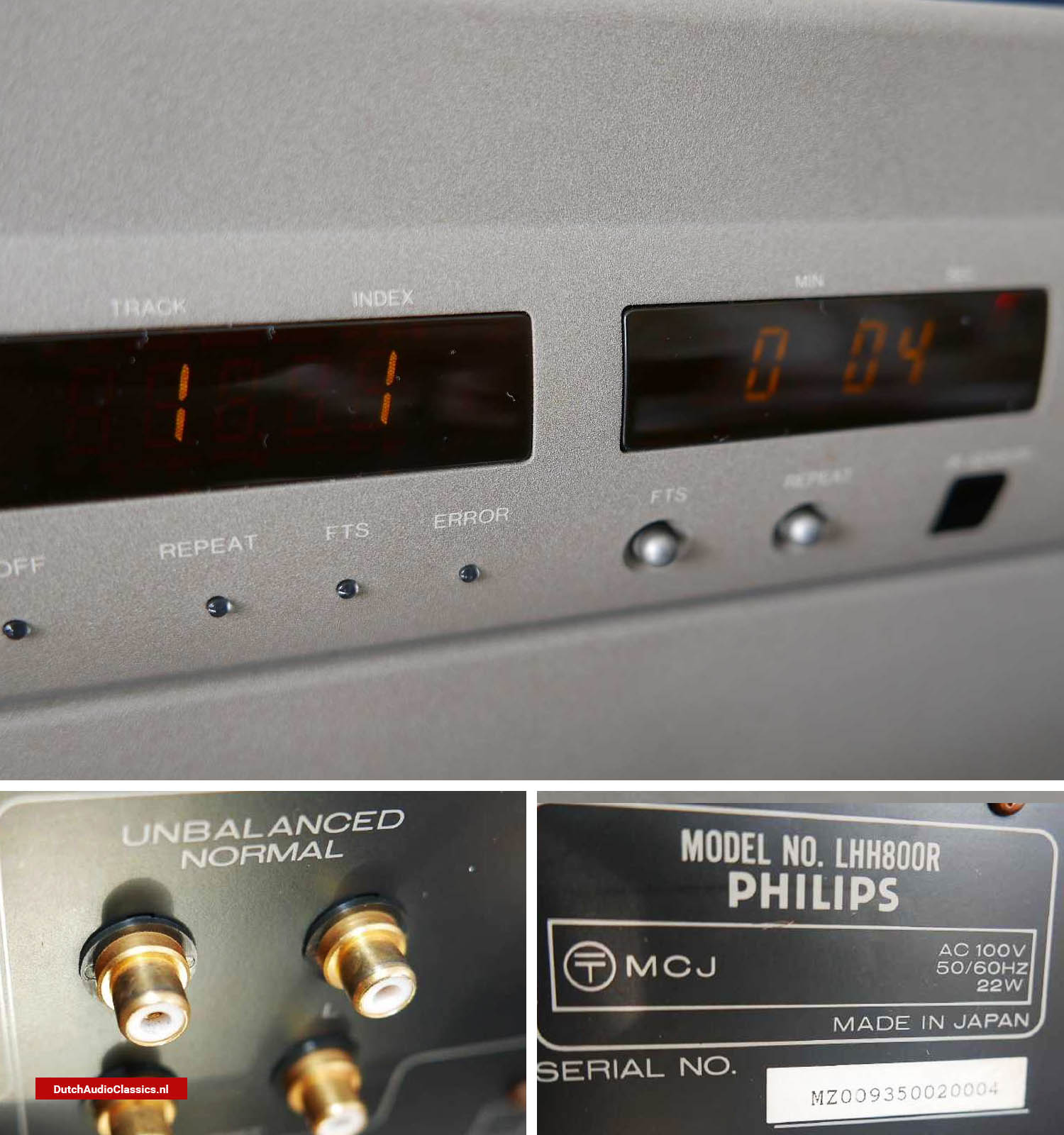
Digital Audio in Transition
The early 1990s were a time of change in digital audio.
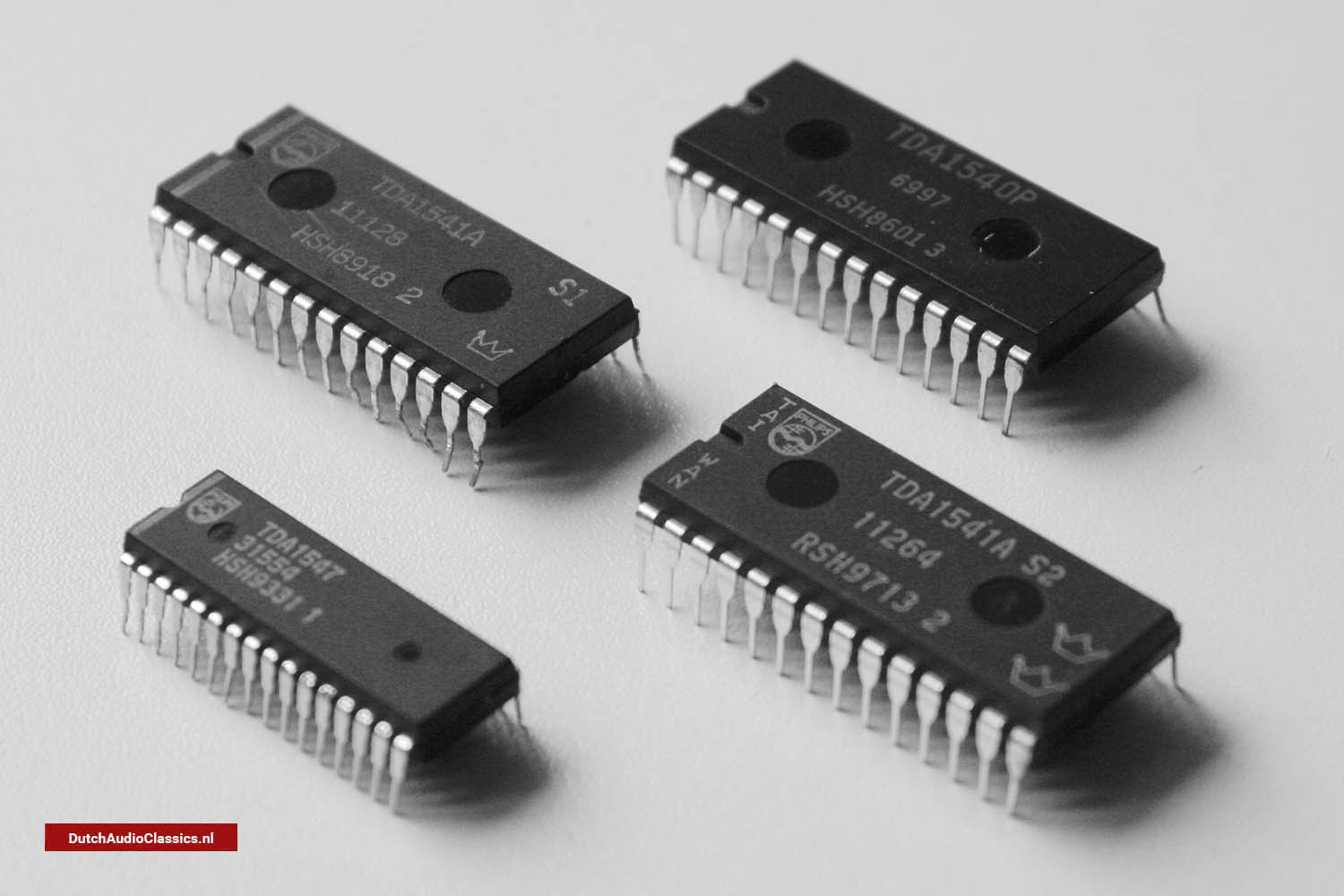
During the late 1980s most CD players used multi-bit digital-to-analog converters. These converters created analog voltages using carefully matched resistor networks. Philips’ well-known TDA1541 is one of the most famous examples.
Multi-bit converters could perform very well. However, they required extremely precise components. Maintaining this accuracy in large-scale production was difficult and expensive.
Around 1990 many manufacturers began moving toward a new approach: the 1-bit bitstream converter.
Instead of generating many voltage levels directly, a bitstream converter produces a very fast stream of pulses. The density of these pulses represents the audio signal. Through a technique called noise shaping, unwanted noise is pushed far above the audible range.
After filtering, the remaining audio band can be very clean and linear.
Philips promoted this concept through its DAC7 platform.
At the same time engineers began paying more attention to the analog output stage. It became clear that digital conversion alone did not determine sound quality. The analog circuitry after the DAC was equally important.
Japanese high-end manufacturers explored many ideas in this area. Some experimented with discrete circuits. Others focused on power supply design or amplifier behavior. The LHH800R was developed in this environment.
The LHH Series
The LHH series was Philips’ dedicated high-end line for the Japanese market.
Japan had one of the strongest audiophile communities in the world at that time. High-end CD players could reach very high prices if they offered special engineering or unusual design ideas.
Early models such as the LHH500 and LHH600 introduced the concept. They combined Philips digital technology with improved mechanical construction and better analog stages. The LHH700 continued this development and raised the level of build quality.
When the LHH800R appeared in 1993, it represented a more ambitious design. It became the reference model of the series. A few years later Philips introduced the LHH900R. This model refined several ideas already present in the LHH800R.
Seen in this context, the LHH800R forms an important step in the evolution of the series.
Mechanical Foundation
The CDM-4 Transport
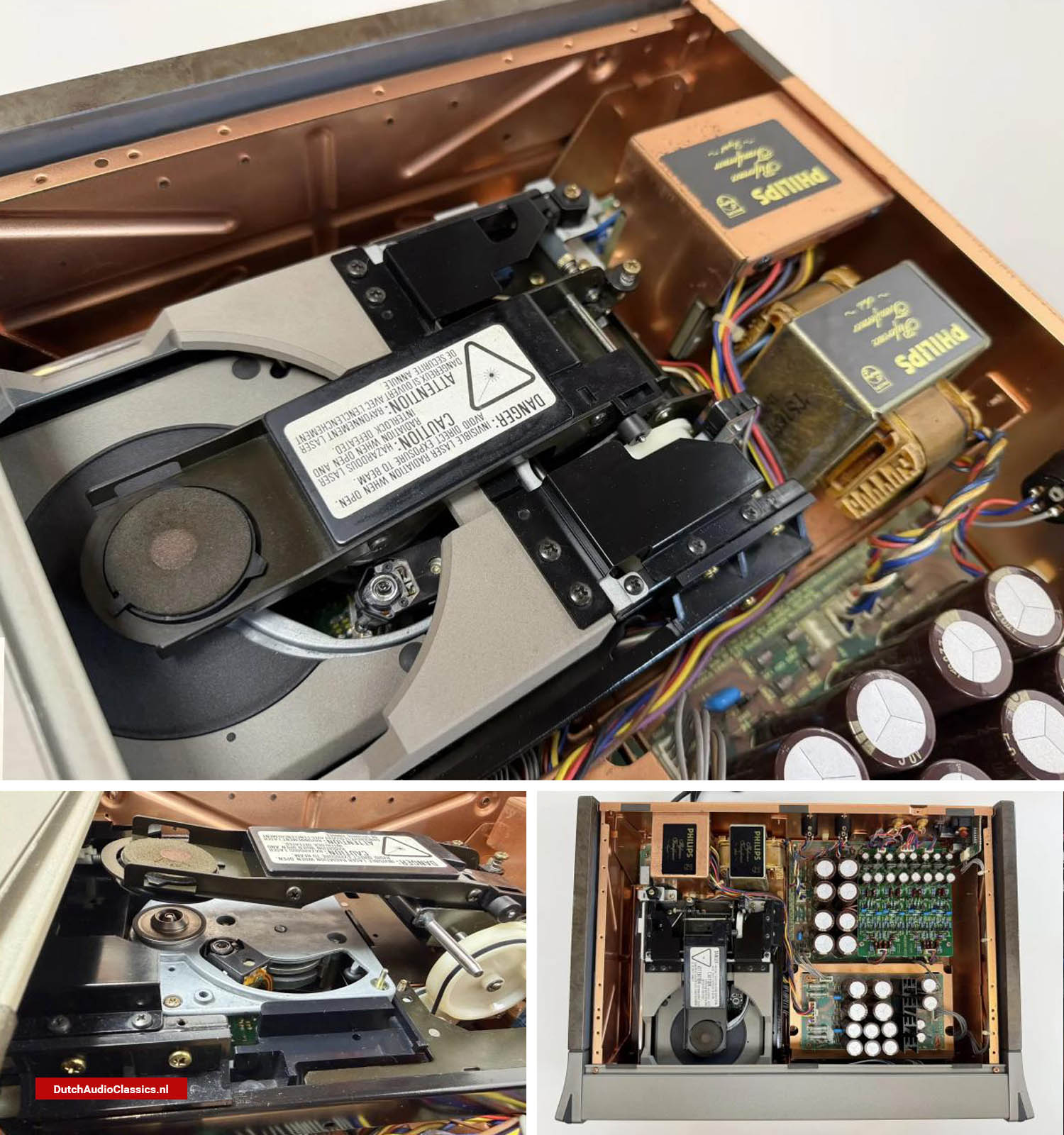
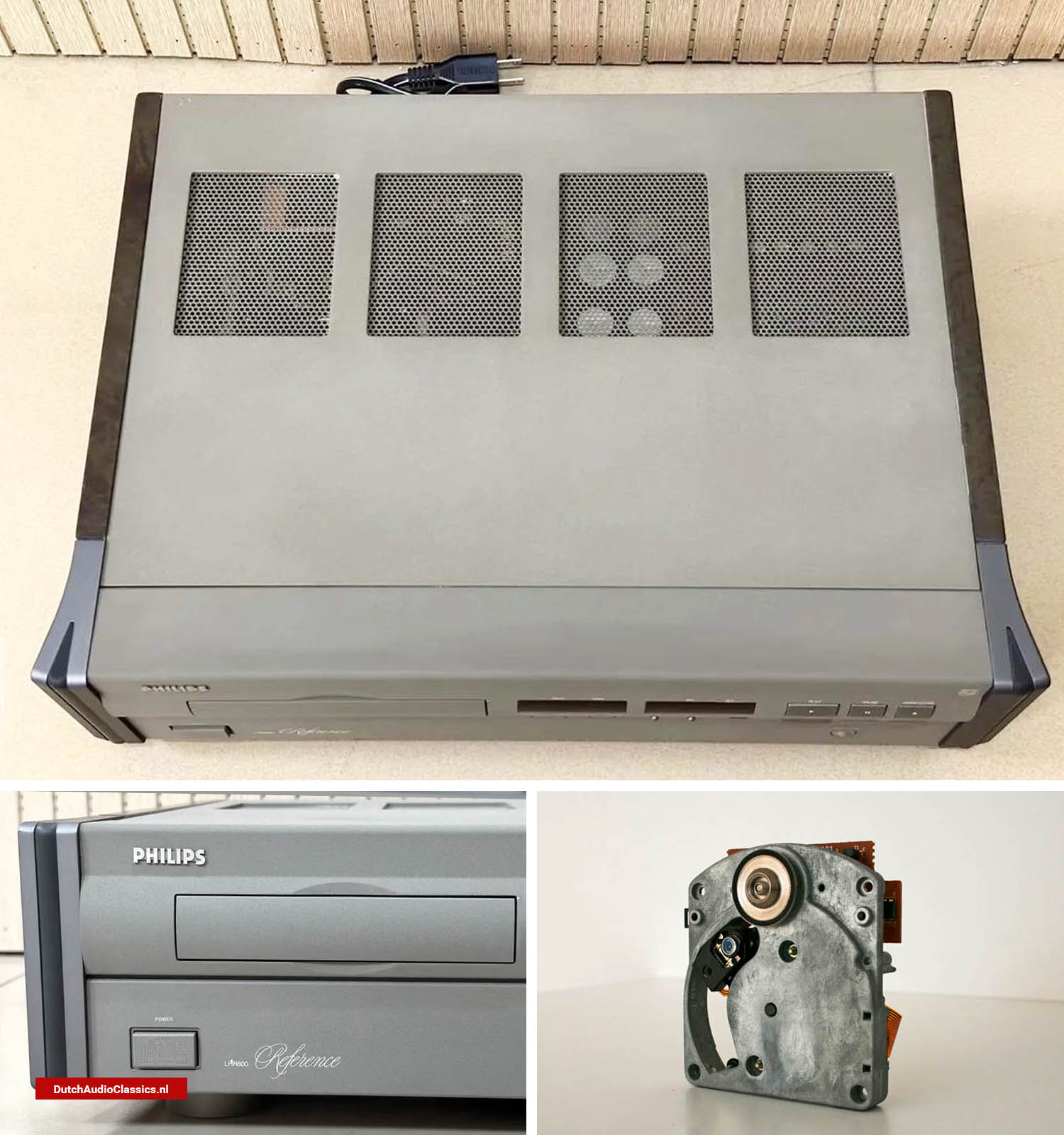
At the center of the player sits the Philips CDM-4 Mini Die-Cast transport. This mechanism belongs to Philips’ well-known swing-arm family. Instead of moving the laser assembly along rails, the optical pickup rotates around a pivot point. The movement resembles that of a tonearm.
This design offers several advantages. The optical geometry remains stable and mechanical friction is reduced. The mechanism also proved very reliable over long periods of use.
The CDM-4 uses a die-cast metal frame. This provides rigidity and keeps the optical system properly aligned. Even today these swing-arm transports are respected for their durability.
Chassis Construction
The internal structure of the LHH800R reflects the design priorities of high-end CD players from that period.
The chassis is copper plated. Copper improves electrical shielding between digital and analog circuits. It also adds mass and helps damp vibration. A thick base plate increases rigidity and gives the player a substantial feel.
Many designers at the time believed that mechanical stability improved both reliability and sound quality. A rigid structure protects the transport and reduces the influence of vibration on sensitive electronics.
The LHH800R clearly follows this design philosophy.
The DAC7 Digital Platform
The TDA1547 Converter
The digital heart of the player is Philips’ DAC7 system.
The converter used in this platform is the TDA1547. It is a 1-bit bitstream DAC.
Instead of producing several voltage levels directly, the chip generates a very fast pulse stream. The density of the pulses represents the audio signal. Noise shaping moves quantization noise into ultrasonic frequencies. These frequencies lie far above the audible range.
After filtering, the remaining signal in the audio band is very linear.
This architecture also avoids the need for extremely precise resistor networks. As a result manufacturing becomes easier while performance remains high.
Digital Processing
Before reaching the DAC the digital signal passes through a processing stage.
The LHH800R uses four-times oversampling. Oversampling increases the effective sampling rate and makes the analog filter easier to design. A digital filter, usually the SAA7350, performs interpolation and prepares the signal for the DAC.
Together these circuits form the complete DAC7 platform.
For Philips this platform represented the future direction of CD playback.
A Deliberate Simplification
Many high-end CD players from this period used dual differential DAC configurations. In those designs two DAC channels per side are combined to reduce noise and distortion. The designers of the LHH800R chose a different approach.
The player uses a single differential DAC topology. This keeps the signal path simpler and shorter. With fewer stages there are fewer interactions between circuits. The analog section can also be optimized more easily.
This decision reflects the broader design philosophy of the player: reduce complexity and focus on signal clarity and speed.
The Analog Stage
The analog output stage is one of the most distinctive parts of the LHH800R. Most CD players from the early 1990s relied on integrated operational amplifiers. These chips simplified design and delivered predictable results.
The LHH800R follows a different path. Its analog stage is fully discrete.
Current-to-Voltage Conversion
The TDA1547 produces a current output. This current must first be converted into a voltage signal. In many CD players this task is handled by op-amps. In the LHH800R the designers bypass the internal amplifier stage of the DAC.
The current signal is taken directly from the chip and converted by a fast discrete circuit.
Output Amplification
After the I/V conversion the signal enters a second discrete stage that provides buffering and output drive. Both stages follow a design approach known as Non-NFB.
Traditional amplifier circuits often use negative feedback to reduce distortion. Feedback can improve measurements, but it also changes how a circuit behaves during fast signal transitions. Non-NFB circuits try to avoid large feedback loops. Instead they rely on simple, wide-bandwidth circuits that operate quickly and naturally.
The analog stage of the LHH800R has a very high slew rate of around 200 volts per microsecond. This indicates that the designers focused strongly on transient speed.
Power Supply Strategy
The LHH800R uses a carefully designed power supply. Inside the chassis are two separate transformers. One transformer powers the digital circuitry. This includes the transport control, digital filter and DAC logic. The second transformer supplies the analog stages.
This separation helps keep digital switching noise away from the analog signal path. Digital circuits produce high-frequency noise that can affect sensitive audio electronics. Separate power supplies reduce this risk and help maintain cleaner operating conditions.
During the early 1990s this approach became common in high-end CD players.
Mechanical Damping
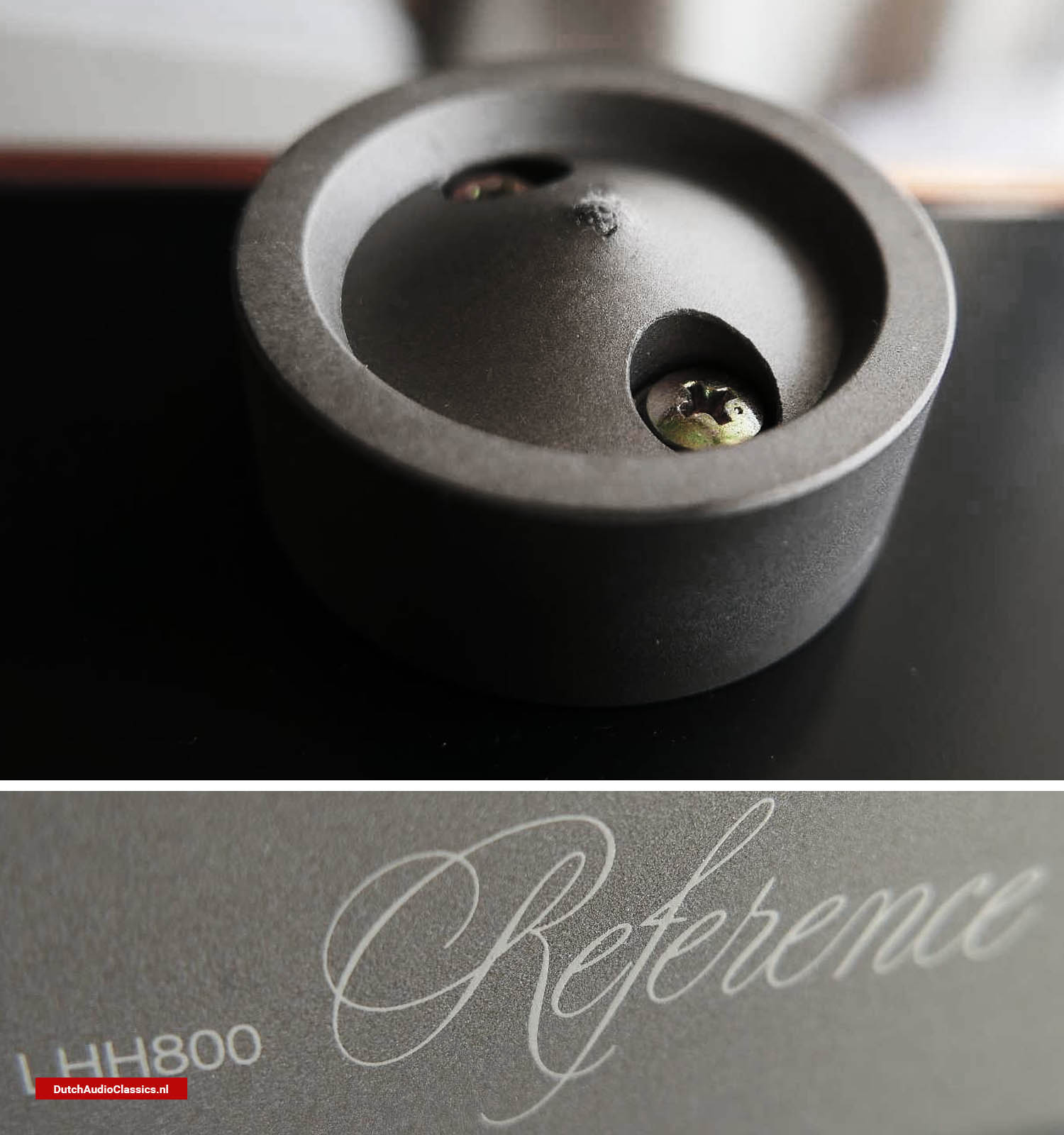
The LHH800R also pays attention to mechanical resonance. The player uses MDF side panels, sometimes called wings. These panels add mass and help damp vibrations in the chassis.
The unit stands on three heavy feet. A three-point support system ensures stable contact with the surface beneath the player. Together with the copper-plated chassis these elements create a stable mechanical structure.
Even though CD playback is digital, the optical transport remains a sensitive mechanical system. Vibrations can affect tracking behavior and servo activity. For this reason many high-end designers paid careful attention to mechanical damping.
Engineering Influence
Several engineers influenced the design philosophy behind the LHH800R. One of them was Tetsu Suzuki from Marantz Japan. Suzuki believed strongly in listening tests during product development. Measurements were important, but final decisions often depended on careful listening.
Tetsu Suzuki’s Design Philosophy
In a 1994 article published in Radio Technology, LHH800R designer Tetsu Suzuki explained the thinking behind the player in unusual detail. His text is valuable because it shows that the LHH800R was not developed as a conventional specification-driven product. It was designed around a clear musical and engineering philosophy.
 Tetsu Suzuki, Marantz Japan engineer involved in the development of high-end Philips-based CD players during the early 1990s.
Beyond Catalogue Specifications
Suzuki argued that after more than ten years of CD player development, the industry had become too focused on increasingly higher numerical specifications that offered little real musical benefit. In his view, measurements remained useful for production control, but they were no longer the best guide for final sound quality.
For the LHH800R, the main target was different. The player had to reproduce the atmosphere of the recording space, the tension of a live performance and the natural tone of acoustic instruments. Final tuning was therefore based heavily on extended listening tests rather than catalogue figures alone.
Simplifying the Signal Path
To achieve better timing accuracy and cleaner transient response, Suzuki favored an extremely simple signal path. One of the clearest examples was the use of the TDA1547 DAC7 converter in single differential mode, rather than the more complex dual-differential arrangements that were popular in many high-end players of the period.
This choice reduced circuit complexity and shortened the path between conversion and output stages. According to Suzuki, simplicity was often more valuable than theoretical gains from additional circuitry.
The same logic appeared in the filtering stage. Instead of using a complex active filter, the LHH800R employed a third-order passive low-pass filter chosen for stable phase behavior and signal purity.
Discrete Analog Design
Suzuki placed great importance on the analog circuitry after digital conversion. Standard integrated op-amps commonly used in DAC output stages were bypassed completely.
Instead, the LHH800R uses a fully discrete symmetrical amplifier stage for current-to-voltage conversion and output amplification. This circuit was designed for very high speed, with a quoted slew rate of around 200 V/µs.
Large global negative feedback loops were also avoided. Suzuki believed that excessive feedback could reduce immediacy and natural flow. The alternative was a wide-bandwidth circuit designed to remain linear through its own operating behavior rather than through heavy correction.
Mechanical and Power Supply Control
The same level of attention was applied to the physical construction of the player. The LHH800R used the proven Philips CDM-4/36 swing-arm transport, valued for its rigid structure, low moving mass and accurate disc reading.
The chassis was copper plated and mounted on three heavy alloy feet in a three-point support arrangement. Suzuki also introduced composite side panels called Wings, intended to control resonance and drain unwanted vibration from the cabinet structure.
Digital and analog circuits each received their own dedicated transformer. This reduced interaction between noisy digital supply lines and the sensitive analog stages.
A Hardware-First Philosophy
Suzuki’s conclusion was clear. Whether a player used 1-bit or multibit conversion was, in itself, less important than the quality of the surrounding hardware. In the LHH800R, converter technology was only one part of the result. Mechanical stability, power supply isolation, fast analog circuitry and careful listening evaluation were considered equally important to natural musical reproduction.
Hideki Kato
Another influential engineer was Hideki Kato. He became known for promoting Non-NFB amplifier techniques. Kato believed that large feedback loops could slow circuit behavior and reduce musical naturalness. This philosophy is clearly visible in the discrete analog stage of the LHH800R.
Technical Architecture Overview
The Philips LHH800R is organized as a sequence of clearly defined functional blocks. The architecture separates mechanical transport, digital signal processing and analog amplification. Each section operates in a largely independent electrical domain. This structure reduces interference and simplifies signal routing.
Transport System
The player uses the Philips CDM-4/36 swing-arm CD transport. This mechanism employs a pivoting optical pickup rather than a linear sled system.
The swing-arm geometry keeps the laser angle constant relative to the disc surface. Tracking corrections require only small mechanical movements. The optical assembly therefore operates with low mechanical inertia.
The mechanism is mounted in a die-cast metal frame. This structure increases rigidity and maintains optical alignment. Mechanical stability is critical for accurate focus and tracking control.
CD Decoder and Servo Control
Disc decoding and servo control are handled by the SAA7345 CD decoder and servo processor. This integrated circuit performs EFM demodulation and error correction.
The device also controls the transport servo loops. Focus, tracking and spindle speed are regulated through feedback control from the optical pickup.
The SAA7345 therefore forms the interface between the optical transport and the digital audio processing chain.
Digital Filter and Oversampling
After decoding, the digital audio signal is routed to the SAA7350 digital filter. This component forms part of Philips’ DAC7 digital processing architecture.
The SAA7350 performs 4× oversampling and interpolation. Additional samples are calculated between the original data points. This raises the effective sampling frequency and reduces the demands placed on the analog reconstruction filter.
The output of the digital filter is formatted for the DAC7 bitstream conversion stage.
DAC7 Bitstream Converter
Digital-to-analog conversion is performed by the TDA1547 DAC7 Bitstream DAC. This converter uses a 1-bit architecture with noise shaping.
Instead of generating multiple voltage levels through a resistor ladder, the DAC produces a high-frequency pulse stream. Pulse density represents the instantaneous amplitude of the audio signal.
Noise shaping shifts quantization noise to ultrasonic frequencies. After analog filtering, the audio band retains high linearity.
Converter Topology
The LHH800R uses a single differential DAC configuration. The design does not employ multiple DACs in parallel or differential pairs.
This choice simplifies the signal path and reduces circuit interaction between converter stages. The architecture prioritizes signal integrity and circuit stability over complex multi-DAC arrangements.
Current-to-Voltage Conversion
The TDA1547 produces a current output signal. This current must be converted to a voltage before further amplification.
The LHH800R uses a discrete current-to-voltage (I/V) conversion stage. The circuit is implemented with individual transistors rather than integrated operational amplifiers.
This approach allows higher bandwidth and faster signal response than typical op-amp based I/V stages.
Discrete Analog Output Stage
After I/V conversion the signal enters a second discrete stage that performs voltage amplification and output buffering.
The analog circuitry follows a Non-NFB design approach. Large global negative feedback loops are avoided.
The circuit relies on wide bandwidth and stable device operation. The output stage achieves a slew rate of approximately 200 V/µs. This indicates a design emphasis on rapid transient response and fast settling behavior.
Power Supply Structure
The LHH800R uses two separate power transformers. One transformer supplies the digital circuitry. The second supplies the analog stages.
This separation isolates the analog signal path from switching noise generated by the digital logic and servo control circuits.
Chassis and Mechanical Stability
The internal chassis is copper plated. The copper layer improves electromagnetic shielding between digital and analog sections.
The player also uses a heavy base structure and additional damping elements. These measures increase mechanical rigidity and reduce vibration.
Signal Flow Summary
CDM-4/36 swing-arm transport
→ SAA7345 CD decoder and servo processor
→ SAA7350 digital filter (4× oversampling)
→ TDA1547 DAC7 Bitstream DAC
→ discrete I/V conversion stage
→ discrete Non-NFB output amplifier
→ analog line output
The LHH800R architecture combines Philips’ DAC7 digital platform with a simplified discrete analog stage. The design emphasizes mechanical stability, controlled digital processing and a fast analog output section.
Reception Among Enthusiasts
Over time the LHH800R developed a strong reputation among collectors and enthusiasts of Philips-based CD players. Listeners often describe the sound as fast and dynamic. Transients are reproduced clearly and with precision.
At the same time the presentation is often described as smooth and natural. This combination is often linked to the interaction between the DAC7 platform and the discrete analog stage. The player therefore represents a unique blend of Philips digital engineering and Japanese analog design philosophy.
From LHH800R to LHH900R
The LHH900R appeared later as a further development of the concept. The later model kept the same basic philosophy. The discrete analog stage and Non-NFB approach remained central to the design. The digital section still relied on the DAC7 platform.
Production numbers were limited, which eventually made the LHH900R quite rare. Seen in retrospect, the LHH800R laid the foundation for this later flagship.
Historical Perspective
Today the Philips LHH800R occupies an interesting place in the history of CD players. The player appeared during a time when digital audio technology was changing quickly. Bitstream conversion was becoming the new standard, while designers were still exploring the best ways to build the surrounding analog circuits.
The engineers behind the LHH800R chose a distinctive path. Instead of adding complexity, they simplified the signal path and focused on very fast analog circuits. For a short period in the early 1990s this approach attracted strong interest among Japanese high-end designers.
The LHH800R remains one of the clearest examples of this philosophy. It combines Philips digital innovation with a unique analog design culture from that era.
This blog places the Philips LHH800R (1993) within the broader transition of digital audio design in the early 1990s. It explains how the player combined Philips’ DAC7 Bitstream architecture with a discrete Non-NFB analog stage developed with Marantz Japan.
By examining both the engineering choices and the people behind them, the LHH800R can be understood as part of a wider exploration of speed, simplicity and listening-driven design during the final formative years of high-end CD player development.